Insect Killer Machine for Hospitals & Clinics: What Compliance Standards Require
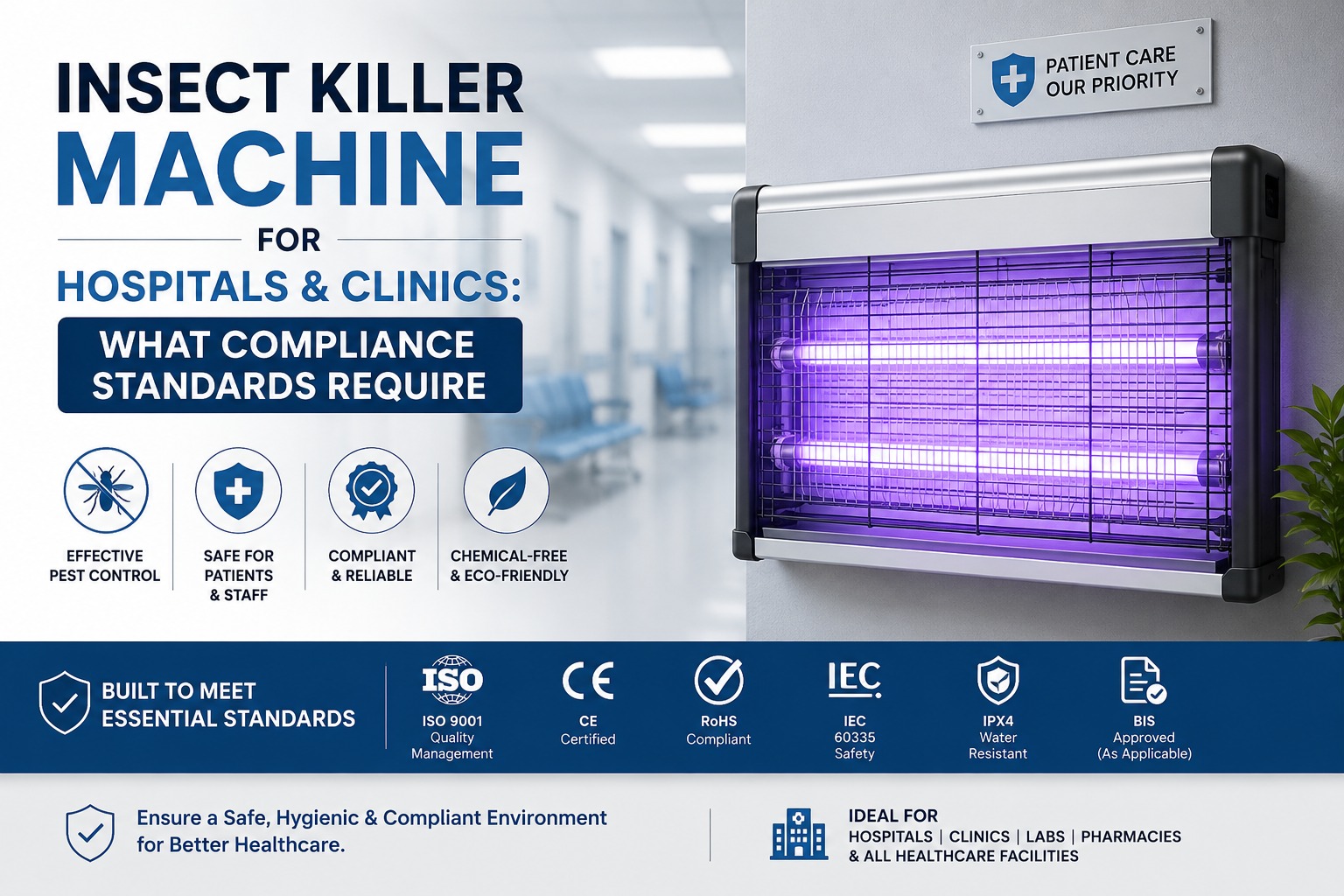
Hospitals and clinics need an insect killer machine because flying insects are a recognised vector for hospital-acquired infections (HAIs), and infection-control frameworks like NABH accreditation require documented pest-control measures as part of facility hygiene compliance. The right machine uses UV light to attract insects and an electric grid to eliminate them without chemical sprays — a non-negotiable requirement in areas like operation theatres, ICUs, and pharmacies where fumigation isn't an option. Placement should prioritise entry points, corridors, and food-prep areas, using an enclosed catchment design so no insect debris contaminates sterile zones.
What Exactly is an Insect Killer Machine?
An insect killer machine (also called an electric fly killer or UV insect trap) is a device that uses ultraviolet light to attract flying insects — flies, mosquitoes, moths — and then eliminates them using a high-voltage electric grid. No spray, no fumes, no chemical residue left behind on surfaces or in the air.
That last part matters more in a healthcare setting than almost anywhere else. Fumigation and chemical sprays are simply not an option in areas where patients are recovering, wounds are exposed, or medicines are stored. An insect killer machine solves the same problem without introducing a new one.
Compliance Area vs What it Actually Requires
|
Compliance Area |
What It Focuses On |
Why an Insect Killer Machine Helps |
|
NABH Accreditation |
Infection prevention & facility hygiene audits |
Provides a visible, verifiable pest-control system with maintenance records |
|
HICC Protocols |
Preventing hospital-acquired infections (HAIs) |
Chemical-free method suitable for use near patients and wounds |
|
FSSAI Guidelines |
Food safety in hospital kitchens/cafeterias |
Enclosed catchment design prevents food-area contamination |
Key Benefits of Using an Insect Killer Machine in Healthcare Settings
-
No chemical exposure: Safe to run continuously near patients, staff, and medicines.
-
Silent or near-silent operation: Won't disturb patients resting in wards.
-
Low running cost: UV insect killers typically use far less power than people expect — most models sit in the 15W to 40W range.
-
Easy to document: A physical device with a cleaning log is far easier to show an auditor than a verbal assurance.
-
Reduces reliance on fumigation: Fewer chemical treatments needed in sensitive zones.
Feature vs Why it Matters
|
Feature |
Why it Matters in a Hospital |
|
UV-A light attraction |
Draws insects away from patient zones and food areas |
|
Enclosed catchment tray |
Prevents insect debris from scattering near sterile surfaces |
|
No chemical spray |
Safe for continuous use around wound care and respiratory patients |
|
Wall or ceiling mount |
Keeps the unit out of trolley and stretcher movement paths |
|
Low-noise operation |
Doesn't disturb patients in wards or waiting areas |
Where Should You Actually Install One?
This is where a lot of facilities get it wrong. Buying the machine is the easy part — placing it correctly is what actually makes it effective and compliant.
Placement Guide by Hospital Zone
|
Zone |
Priority |
Reasoning |
|
Entry points & corridors |
High |
First line of defence before insects reach clinical areas |
|
Kitchen & cafeteria |
High |
Directly tied to FSSAI food-safety compliance |
|
Pharmacy & supply storage |
High |
Protects packaged medicines from contamination |
|
Waste & biomedical disposal rooms |
High |
Highest insect-attraction risk in the entire facility |
|
General wards |
Medium |
Needs quiet, continuous operation |
|
Operation theatres / ICUs |
Use with caution |
Usually handled through dedicated HVAC/air-filtration protocols — check internal policy first |
FAQs
Q1. Is an insect killer
machine safe to use around patients?
Yes. Hospital-grade models use UV
attraction and an enclosed electric grid with no chemical release, making them safe for
wards, corridors, and waiting areas when placed correctly.
Q2. Do hospitals legally need
one for accreditation?
There's no single law naming this
exact device, but pest and vector control is a documented requirement under NABH standards
and FSSAI kitchen rules. An insect killer machine is the most practical way to meet that
expectation.
Q3. How often should the
machine be cleaned?
Every 2–3 days in high-activity
areas like kitchens and waste rooms, and weekly in lower-traffic zones like general
wards.
Q4. What size or wattage do I
need for a hospital reception area?
A 15–20W unit typically covers a
small-to-medium reception or consulting room. Larger lobbies or multi-bed wards usually need
30–40W for full coverage.
Q5. Can it replace
professional pest control services?
No. It handles flying insects
specifically. Crawling insects, rodents, and drain-based pests still need scheduled
professional pest control alongside it.
Q6. Where shouldn't I
install an insect killer machine?
Avoid placing units directly over open
wounds, sterile fields, or exposed medical equipment. Operation theatres and ICUs usually
rely on dedicated HVAC and air-filtration protocols instead — always check your
facility's internal infection-control policy first.
Conclusion
Insect control in a hospital or clinic isn't optional, and it isn't something a single fumigation visit can solve. It's a continuous, documented, chemical-free requirement built into how accreditation bodies and infection-control committees evaluate facility hygiene. An insect killer machine placed correctly, maintained on schedule, and paired with entry-point barriers like PVC strip curtains or air curtains gives facility managers a compliant, low-maintenance way to close that gap.
Ready to equip your hospital or clinic with a compliant, hygiene-first insect control solution?
Explore Universal Plastics' Insect Killer Machines or contact our team for a facility-specific recommendation, including matching air curtains and PVC strip curtains for a complete barrier system.
Phone: +91-9811143598, +91-9891143599, +91-9811143597
Email: info@clearviewindustries.in | info@universalplastic.in
Website: www.clearviewstripcurtain.in